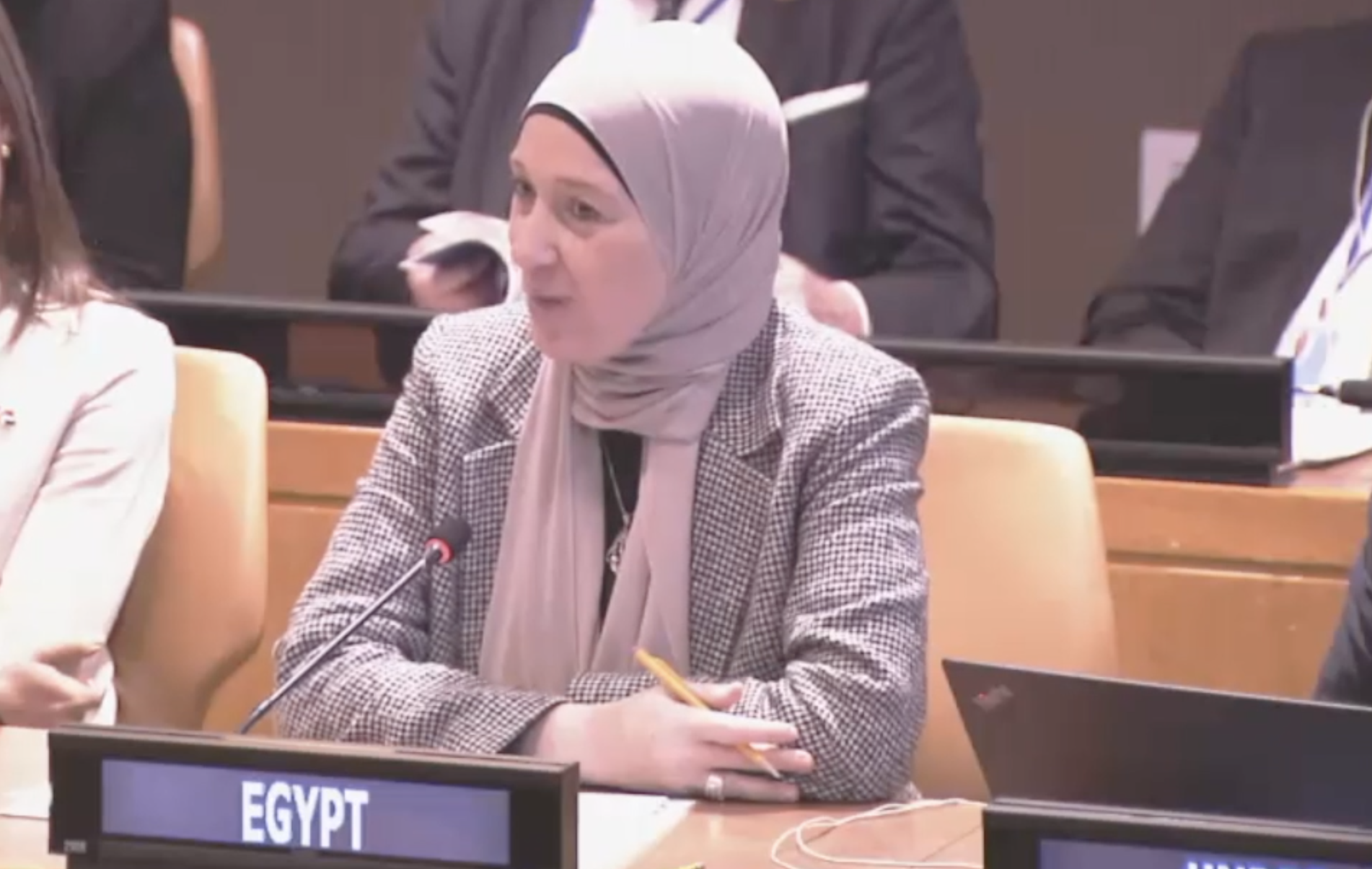

At the INFF Facility: Country-led dialogue on the sidelines of the 2026 FFD Forum, held on 20 April 2026 at UNHQ, Dr. Mona Essam Fayed, Assistant Minister of Planning and Economic Development, Egypt shared how it is moving its Integrated National Financing Strategy from launch to implementation.
The speech highlights Egypt’s whole-of-government approach, including a Financing for Development Working Group, new planning and public finance laws, sectoral working groups, costing exercises and efforts to identify financing gaps. It also points to Masdar, Egypt’s sustainable development monitoring and reporting platform, as a tool to improve data quality and localised reporting.
The intervention underlines the role of UN coordination, innovative finance, blended finance, debt swaps, green and Panda bonds, and country-owned platforms in building a more coherent financing ecosystem that links resources to real development impact.
You can find the full script below:
It is a real honour to be here and to join this distinguished panel to share Egypt’s progress in advancing its Integrated National Financing Strategy, which was launched in 2025 and stands as a real testament to Egypt’s commitment to a comprehensive, coordinated and forward-looking approach to financing for sustainable development.
As you rightly said, it is fully aligned with the national agenda, Egypt Vision 2030, as well as with the global INFF framework.
Moving forward after the launch of the strategy, it has been anchored in a whole-of-government approach. We have been working very diligently on strengthening coordination among different stakeholders in the economy as a whole, as well as creating structured avenues for engagement with development partners and international financial institutions to support Egypt’s financing priorities.
As has been rightfully said, financing for development has two main elements, or two main keywords: finance and development. Central to the operationalization of the financing strategy was the need to find an institutional mechanism or catalytic platform that would support the implementation of this strategy.
This was achieved through the development of a Financing for Development Working Group, which was established under the direction of the Egyptian Presidency and formalized by a Prime Ministerial decree. It includes different ministries and national focal points related to financing for development in Egypt.
We have been working on putting in place a clear roadmap for this working group, with key functions and strategic directions. The overarching objective is to ensure alignment between development and financial planning within policy frameworks, in order to advance sustainable and inclusive development in Egypt.
What has also supported this is the legislative foundation provided through two very important laws that have been passed: the new Planning Law and the Unified Public Finance Law. These act as a legislative foundation for the operationalization and institutionalization of integrated, results-based planning, aligning financial flows with targeted development outcomes and enhancing coherence between development planning and financing planning.
Moving from policy to practice, we have set out the workplan of this working group around two distinct yet interconnected tracks.
The first is related to the sectoral working groups, which assist as a technical office in the preparation of Egypt’s medium-term sustainable development plan. These sectoral groups work closely to settle on development priorities across different sectors in Egypt. They are backed by costing exercises, financial landscaping and calculations of the financing gap.
This was a very clear step in informing robust resource mobilization and guiding investment decisions and the allocation of resources to where they are truly needed.
The second track is focused on the financing of development priorities and gaps. From the first track, we identify the priorities that we need to work on. Here comes the main function of the Financing for Development Working Group, which is to advise on mobilizing resources, allocating the resources needed to bridge the financing gap in each priority, identifying the appropriate modes of finance for different priorities and working to improve resource allocation.
The approach aims to ensure the efficient allocation of resources to where they are most needed. In doing so, it fosters evidence-based and impact-driven financing that advances real sustainable and inclusive development outcomes.
Another track that we have been working on very closely and taking very seriously is data.
We know that what cannot be measured cannot be impacted. We had a problem not with the availability of data, but with its precision, the unification of methodologies and how well it truly reflects what is behind the numbers. It is not only about data statistics, but about the people behind the numbers.
So we have been working on a monitoring, sustainable development and reporting platform called Masdar. In Egypt, this means a trustworthy source of data. It is a government-to-government platform that is automatically fed with sustainable development data across all agendas: national, regional and international, as well as localized data. We have also been working on different datasets at the local level and at the governorate level.
This is supposed to strengthen effective monitoring and reporting on sustainable development, which is again very important to achieving the targets of financing sustainable development.
Following the high-level launch of the financing strategy, and in the context of the outcomes of the Sevilla Commitment and the Fourth International Conference on Financing for Development, there was a clear need to strengthen the coordinated efforts and support of the UN system to the government. We wanted to make sure that there is coherence, that there is no duplication and that we can leverage the collective technical support of UN entities in Egypt.
Here came the effort of the UN country team in setting up a UN Financing Task Force, coordinated by the Resident Coordinator’s Office and technically led by UNDP, UNICEF and ESCWA.
This UN task force serves as an inter-agency coordination platform for financing for development in Egypt. It leverages technical expertise and creates a repository of all initiatives and all support related to innovative instruments, blended finance, work on country platforms and other areas, bringing it all into one place.
It also ensures coordination between this task force and the national Financing for Development Working Group, as well as the Sustainable Finance Working Group led by the Ministry of Finance and the oversight committee recommended in the financing strategy that was launched.
As you have seen, as Egypt works on this very important portfolio, we are targeting a coherent and integrated financing ecosystem. This includes strategic planning itself, the financing instruments that are put forward and the strong institutional coordination that we are trying to foster.
The national momentum is further reinforced by a broader set of initiatives: performance-based budgeting, innovative financing tools, including sovereign, Panda and green bonds, the debt swap programmes that Egypt is working on very diligently, and, as you have said, country-owned platforms, which are a very good modality when we talk about mobilizing climate finance and private investment.
All these efforts are fully aligned with the renewed global financing for development framework, the Sevilla Commitment, and underscore the central role of such financing frameworks and country-led platforms in closing the development gap.
Egypt is working on two of the Sevilla Platform for Action initiatives. There was also the launch of the Borrowers Platform last week during the Spring Meetings, and Egypt is taking a big role in that.
To end, maybe I can reflect on the challenge we are facing. I would say that the problem is the disconnect, or sometimes the difficulty in capturing where the problem comes from. Is it from the financial allocations themselves? Is it in the way resources are allocated to our priorities?
Being able to measure real impact that advances development is the ultimate purpose of what we are doing here. It is not finance for its own sake, or mobilizing resources for their own sake. It is about creating an opportunity to improve the lives of our citizens.
So how can we really quantify where the successes are and where the drawbacks are? Is it coming from allocation? Is it coming from the mobilization of the resources themselves? Is it in the way we are steering the whole process?
I think this is what is missing, and what we hope to work on in the coming phase.
Thank you so much.







.png)