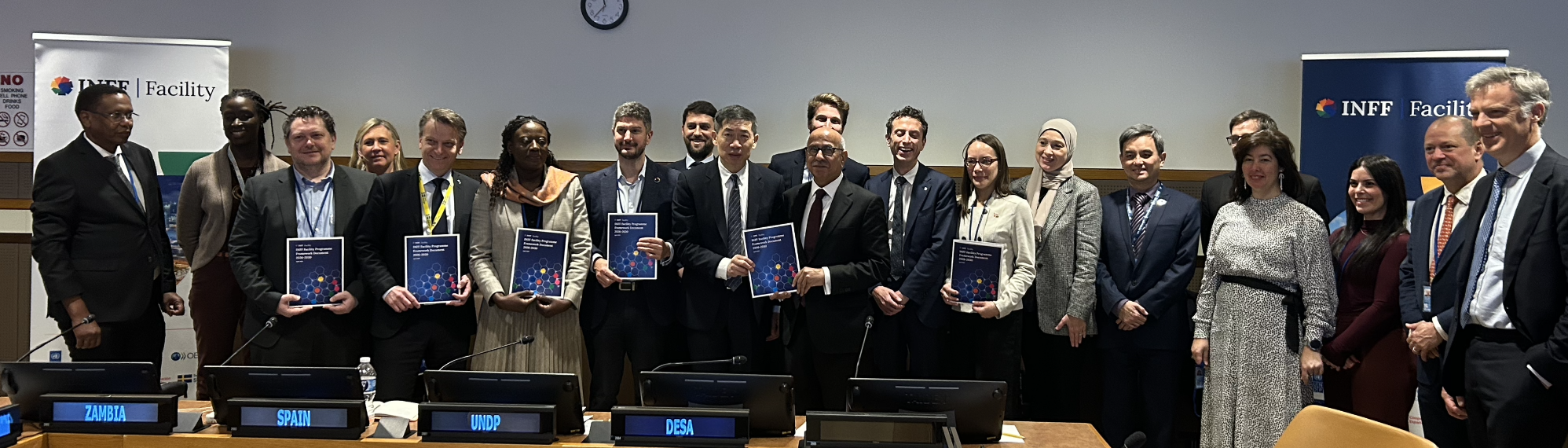
Keeping the momentum of the Sevilla Commitment and Platform for Action, governments, UN entities, development partners, public development banks and other stakeholders came together at the first annual INFF Facility country-led dialogue, held on the sidelines of the 2026 FFD Forum. They came together to discuss a question that sits at the heart of financing for development: how can countries turn national priorities into practical financing strategies and reforms that deliver results? We’ve summarized five takeaways for you below. You can also watch the event recording here.
1. Country leadership is the catalyst for innovation
When it comes to INFF reforms, “ownership by the government throughout the implementation process is key,” said Ms. Perla Noemi Soto Veloz, Head of the Department of Strategic Analysis and Foresight, Ministry of Finance and Economy, Dominican Republic. She highlighted key reforms, including the development of a world-first AI-powered, multi-sector SDG budget tagging. This is one of the strongest messages from the dialogue and reflects the DNA of INFFs.
This message was echoed by the opening speakers. “This Facility exists to respond to your leadership, your ownership, your priorities, and your demand,” said Mr. Haoliang Xu, Associate Administrator, UNDP. Mr. Navid Hanif, Assistant Secretary-General, UN DESA, reinforced this by describing the meeting as “the listening exercise” to hear from countries. Meanwhile, Mr. Sergio Colina, Director General for Sustainable Development Policy, Ministry of Foreign Affairs, European Union and Cooperation, Spain, added that “when countries are really able to align their priorities, policies and resources, then development finance becomes more effective and also more transformative.”
2. From framework to action: countries’ experiences
Countries came with concrete examples of how they are turning their INFF processes into action.
“We are targeting a coherent and integrated financing ecosystem, be it the strategic planning itself, the financing instruments that are put ahead, and the strong institutional coordination that we're trying to foster.” - Dr. Mona Essam Fayed, Assistant Minister of Planning and Economic Development, Egypt
Dr Fayed presented Egypt’s 2025 financing strategy as a whole-of-government approach aligned with Vision 2030, backed by new laws and high-level coordination. The model links sector planning with financing strategies and is supported by data systems to track results.
“INFF can directly support inclusive economic growth... reduce risk and unlock private capital at large in power.” - Mr. Rished Bade, Acting Deputy Permanent Secretary, Ministry of Finance and Planning, Tanzania
Mr. Bade shared an update on implementation in Tanzania, including efforts to align national development planning with financing strategies and mobilizing through green bonds, sukuk, blended finance, tax reform and investment pipeline development.
“INFF should be thought of as a tool that supports strategic decision making, and it is also a support for sovereignty” - Dr Larba Issa Kobyagda, Director General, Economy and Planning, Ministry of Economy and Finance, Burkina Faso
Dr Kobyagda noted that Burkina Faso’s INFF operates in a fragile, security-constrained context with limited external financing. Launched in 2019, the multi-stakeholder steering committee has overseen financing diagnostics and is now developing the national financing strategy. It supports stabilization and recovery by combining domestic reforms with broader development efforts, focusing on better use of existing resources. He also emphasized the need to elevate INFFs politically, accelerate implementation, use ODA and private finance as catalysts, and better align planning, budgeting, and results.
“INFF has been a tool to help us with national funding and provide a more updated vision of how we can face our development challenges... that's made it possible for us to implement many programs” - Ms. Soto Veloz
The Dominican Republic’s INFF builds on its National Development Strategy 2030, adding the financing framework needed to deliver national goals. Ms. Soto Veloz highlighted that the INFF has helped align planning with actionable financing, reduce fragmentation, and produce key outputs, including a priorities agenda, cooperation diagnostic, and key financing options. She highlighted three lessons: anchor INFFs in strong institutions, ensure government ownership, and deliver quick wins. The strategy also advances SDG tagging, including AI-enabled tools integrating climate and gender.
“Our aim really is to align our INFF with our medium-term development planning framework.” - Ms. Prudence Kaoma, Permanent Secretary, Planning and Administration, Ministry of Finance and National Planning, Zambia
Zambia is integrating its INFF into its medium-term planning cycle as it moves from the Eighth National Development Plan to the Ninth (2027–2031). It has completed development finance assessments at both national and district levels and developed tools on domestic resource mobilization and innovative financing, while now working toward a full financing strategy aligned with national planning and budgeting.
3. Quality, coherence and institutions matter
The dialogue highlighted a hard truth about financing for development: more money alone is not enough. What matters just as much is whether financing is aligned with national strategies, whether institutions can manage it and whether governments can track results. As Olivier Cattaneo, Head of the Policy Analysis and Strategy Unit, OECD, noted, “It is important to anchor the financing strategies in the national development strategy so that financing supports the development strategies and not the other way around.”
This came through strongly in Egypt’s intervention, which focused not only on mobilising resources but on connecting priorities, budgeting, data, and monitoring. This enables governments to see whether finance is improving people’s lives. The emphasis on coherence was also reflected through the Dominican Republic’s intervention, which called for stronger benchmarking and a common indicator framework to align financing needs with development needs.
Cons. Stefano Lo Savio, Head, Sustainable Finance, Environment and Digital Unit, DGCS, Italian Ministry of Foreign Affairs, argued that the international system needs to shift from focusing on the quantity of aid to its quality and systemic impact. Similarly, Mr. Kjell Forsberg, Assistant Director General and Head of Department for Trade, Private Sector and Financial Instruments, SIDA, stressed that financing gaps cannot be closed by money alone if institutions, governance, and absorptive capacity are weak.
4. Climate, resilience and local finance need to be integrated into mainstream financing frameworks
Climate, resilience and local development cannot sit in separate silos - they need to be built directly into national financing frameworks. Zambia spoke about how climate shocks, especially drought, are reshaping financing needs. Tanzania highlighted agriculture insurance and financial resilience as major frontier issues. Egypt and the Dominican Republic both described efforts to integrate climate and gender into broader financing systems, underscoring that countries are no longer looking for parallel conversations on climate and other priorities. They are looking for financing systems that can handle multiple priorities at once.
Ms. Catherine Diam-Valla, Climate Change Technical Specialist, UNDP, argued that climate ambition should not remain on paper or in separate processes. Countries need support that links NDC implementation to wider national financing systems. Mr. Mathieu Verougstraete, Head of Infrastructure and Finance for Resilience Unit, UNDRR, made the case for integrating disaster risk reduction into budgeting, fiscal risk analysis and investment planning.
Ms. Marta Méndez, National Coordinator, Local2030 Coalition, highlighted that “local finance is development finance”. She emphasized the SPA’s target to scale to 40 local financing frameworks globally by 2030, improving alignment between financing sources and SDG priorities at the city and regional level. Similarly, Mr. David Andrés, Head of the Delegation to the United States and Canada, Regional Government of Catalonia, Spain, underlined that national strategies will only deliver if they connect with the financing realities of cities, regions and local governments.
5. Partnerships that respond to sovereign priorities and the role of the INFF Facility
Across the dialogue, speakers emphasized that the real challenge is not simply to mobilise more actors, but to make support more coherent around country-led priorities.
Mr. Ping Yean Cheah, Senior Partnership Officer, Asian Infrastructure Investment Bank, highlighted the need to strengthen capacity to build bankable project pipelines, as well as the broader ecosystem needed to finance them.
Laura Sabogal, Manager for Climate and Development Finance, FiCS and IDFC, pointed to the potential for public development banks to better integrate into national financing frameworks, given their scale and operational importance.
The key takeaway is that partnerships work best when they are organised around sovereign strategies, pipelines, and institutions.
Overall, the country-led dialogue positioned INFFs as a practical political and technical platform for addressing real problems: fragmented finance, weak alignment, limited fiscal space, and underdeveloped project pipelines. Governments, UN entities, development partners, development banks and local actors all pointed in the same direction- country-led financing frameworks are becoming one of the most effective ways to connect strategy, institutions, investment and delivery.
In response to the priorities articulated by countries in the dialogue and throughout the first phase of its operations, the INFF Facility used the event to launch its 2026-2030 Programme Framework Document. Bringing together UNDP, UNDESA, UNICEF, and the OECD, the European Union and the Governments of Canada, Italy, Spain, and Sweden, the Facility remains the only dedicated global mechanism supporting the implementation of country-led INFFs.






.png)